Selling abroad starts with being found abroad.
A UK site that ranks well in London often shows up in the wrong language, the wrong currency or not at all in Paris, Frankfurt or New York. Google needs clear signals about which page belongs to which market, and buyers need content written for how they search, not a translated copy of your UK homepage.
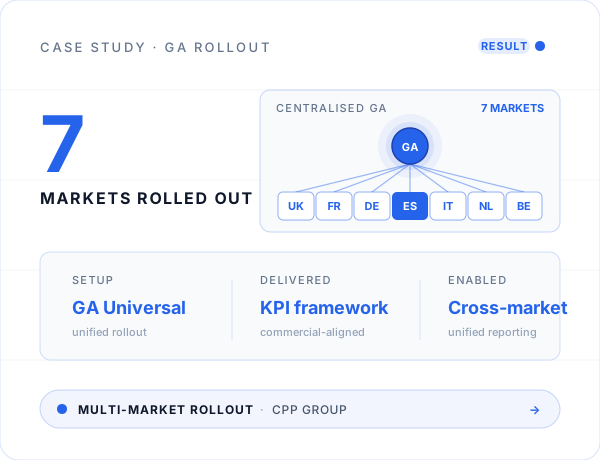
My background is multi-market measurement: global ecommerce performance for Philip Morris International across 50+ markets, and a Google Analytics rollout across seven countries for CPP Group. International SEO puts the same discipline in front of the search engines, so each market is set up, indexed and measured on its own terms.
Everything a second market needs to rank.
Keyword Research per Market
Separate research for every country and language. Search terms, volumes and intent differ, even between the UK and the US.
Domain Structure
A clear recommendation on country-code domains, subfolders or subdomains, weighed against your budget, teams and growth plans.
Hreflang Implementation
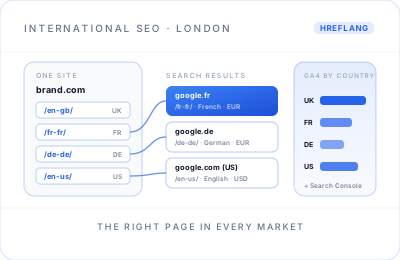
Hreflang annotations with return links and an x-default, placed in the page head or XML sitemap and checked for errors.
Localisation, Not Just Translation
Currency, units, spelling, legal pages and examples adapted for each market, with translators briefed on the keywords that matter there.
International Technical Setup
No forced redirects by IP address, a crawlable language switcher, correct canonicals and fast loading for visitors outside the UK.
Search Console & GA4 by Market
A Search Console property per market and GA4 reports split by country, so each market's traffic, enquiries and revenue are visible.
Start With the Markets That Pay
Not every country deserves a full launch on day one. I help you prioritise using search demand, competition and the data you already have, then expand once the first new market proves itself.
ccTLD, subfolder or subdomain: which one fits?
There is no single right answer, but there is usually a right answer for your business. This is how the three options compare for a company growing out of London.
| Country-code domain (brand.fr) |
Subfolder (brand.com/fr/) |
Subdomain (fr.brand.com) |
|
|---|---|---|---|
| Country signal | Strongest: a clear local domain | Clear, with hreflang and Search Console set up | Clear, with hreflang and Search Console set up |
| Shares authority with your main site | Each domain builds its own | Yes, one domain | Partly; often treated separately |
| Cost and admin | Highest: domains, hosting and registry rules per country | Lowest: one site, one CMS | Medium: separate setup per market |
| Local trust for buyers | Strong | Good | Good |
| Best for | Established brands with local teams and budgets in each country | Most growing businesses entering new markets | Markets that need a separate platform or hosting |
Some country-code domains have registration rules, such as needing a local or EU presence. Check the registry's current requirements before you buy one.
From one market to many, in the right order.
Market Priorities
Which countries, which languages and what success looks like in each, based on demand and the data you already hold.
Keywords by Market
Native-language research for each market, mapped to the pages you already have and the pages you will need.
Structure & Hreflang Map
Domain structure, URL patterns and a hreflang map for every page pair, ready for your developer or for me to implement.
Localised Pages
Briefs for translators or local writers covering keywords, currency, examples and calls to action for each market.
Index Each Market
Sitemaps submitted, Search Console properties verified and hreflang errors cleared before the new market is announced.
Measure by Country
GA4 and Search Console reporting split by market, so budget and effort move to the countries that respond.
The international SEO mistakes I see most often
Most of these are quick to fix once found, and expensive to leave in place, because they quietly stop a whole market from ranking.
- Redirecting visitors automatically by IP address, which can stop Google seeing your other versions because it mostly crawls from the US
- Hreflang tags without return links, so Google ignores them
- Machine translation published without a native-speaker edit
- One Search Console property covering every country, hiding market-level problems
- Prices in pounds on pages meant for euro or dollar buyers
Multi-market measurement at enterprise scale.
Philip Morris International: global ecommerce performance monitoring and a standardised KPI framework across 50+ markets. CPP Group: Google Analytics across seven markets, from the UK and Germany to Hong Kong and Brazil, with one centralised global view. River Island: a migration from Adobe Analytics to GA360 across nine international domains. These were analytics programmes rather than SEO retainers, and they are why every international SEO project I run is measured market by market.
Read the PMI case studyInternational SEO for London businesses ready to grow abroad.
London is one of the easiest places in the world to start selling internationally, and one of the easiest places to get international SEO wrong. Plenty of London businesses launch a French or German version of their site, see a trickle of visits and conclude the market isn't interested. More often, Google never understood which pages were meant for which country, and the few visitors who did arrive found prices, delivery details and examples written for someone in the UK.
International SEO fixes that at the foundations. It starts with a decision on structure, whether that means country-code domains, subfolders on your main domain or subdomains, and continues with hreflang, localised content and an honest look at demand in each market. The same technical SEO principles apply as at home, multiplied by every country you add. If you sell online, ecommerce SEO brings currency, shipping and product feed decisions on top.
Measurement matters just as much. I set up GA4 so revenue and enquiries can be reported by country, and Search Console so an indexing problem in one market can't hide behind healthy numbers in another. AI assistants increasingly answer in the searcher's own language too, so well-structured local content also supports AI search optimisation in each market.
I work remotely with London businesses and their developers, translators or overseas teams. If you're not sure whether your current site is ready for a second market, the free SEO audit is a sensible first step, and SEO pricing is set out openly before you commit to anything.
Common questions.
Structure, hreflang, translation and measuring each market.
International SEO is the work that helps search engines show the right version of your website to people in each country or language. It covers domain structure, hreflang tags, localised content, keyword research for every market and separate reporting, so a buyer in Germany finds your German page rather than your UK one.
For most growing businesses, subfolders on one domain, such as brand.com/fr/, are the sensible default: one site to maintain and shared authority. Country-code domains send the strongest local signal but cost more to run and build authority separately. Subdomains suit markets that need a separate platform. The right choice depends on budget and teams.
Hreflang tells Google which language and country each version of a page is for, and which pages are equivalents. It helps the right version appear in each market and stops near-identical English pages for the UK, US and Australia competing with each other. Every page must link back to its alternates, or Google may ignore the tags.
No. Translation converts words; localisation adapts the page to how people in that market search and buy. Keywords often differ from a literal translation, and currency, spelling, units, examples and legal pages need changing too. I brief translators with target keywords per market, so the finished page reads naturally and ranks for real searches.
Add a Search Console property for each market's domain, subdomain or subfolder, and configure GA4 so traffic, conversions and revenue can be reported by country and by site section. Then compare each market against its own baseline rather than the UK. Without this split, one strong country can hide problems in another for months.
Usually, yes. Most UK sites can add markets through subfolders without a rebuild, provided the platform supports multiple languages, currencies and hreflang. I check your current setup first, then plan URL patterns, redirects and content for the new market, so your existing UK rankings are protected while the new version is indexed.