Most café visits start with a phone and a map.
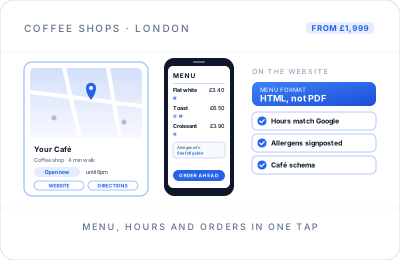
Someone searches for coffee or brunch nearby, taps your listing, checks you are open, glances at the menu and walks over. The whole decision takes under a minute. A café website’s job is to confirm the answers in seconds: open now, what’s on, where you are, and how to order ahead.
I spent time on Costa Coffee’s digital measurement and reporting, analysing how customers used its app and website. That was analytics work, not a website build, but it shaped how I design for short, practical journeys on a phone, and how I measure what an independent café’s site actually delivers.
Everything a café site needs, nothing it doesn’t.
Menu Pages, Not PDFs
Drinks, food and specials as proper web pages you can edit in a minute, readable on any phone and visible to Google.
Order Ahead & Delivery
Clear buttons for click and collect and your delivery app listings, so hungry customers are never more than one tap from ordering.
Opening Hours You Can Trust
One place to edit hours, with bank holiday and closure notices, kept in line with your Google Business Profile.
Events & Private Hire
An events page for cuppings, workshops and supper clubs, and a hire form that asks the right questions up front.
Local SEO Foundations
Address, neighbourhood and café schema on every page, matched to your Google Business Profile so “near me” searches can find you.
Roastery Shop
For roasters: beans by origin and roast, grind options, subscriptions and a wholesale enquiry route for offices and other cafés.
Allergen Information, Clearly Signposted
Every menu page tells customers how to get allergen information, and ordering pages show it before checkout, so the website supports what your team says at the counter.
Food rules your website should work with, not against.
Allergens, labels and calories online
Most of the food information rules are about what happens at the counter and on the label, but the website touches several of them. These are the points I plan menu and ordering pages around.
- Allergen information. Food businesses must be able to give customers information about the 14 major allergens in the food they serve. Many cafés do this at the counter or with an allergen matrix; the website should at least tell customers how to get it.
- Food ordered online. For food sold online or by phone, Food Standards Agency guidance says allergen information must be available before the purchase is completed and again when the food is delivered. That covers your own order-ahead pages as well as delivery app listings you manage.
- Grab-and-go food. Food made and packed on site before it is ordered, such as sandwiches in a fridge, falls under prepacked for direct sale labelling rules (often called Natasha’s Law). That is a label requirement, but your online menu should not contradict it.
- Calories on menus. In England, businesses with 250 or more employees must show calorie information on menus, including online menus. Most independents are below that threshold, but growing groups should check.
I give this information a proper home on the website. It is not food safety or legal advice: check the current Food Standards Agency guidance and speak to your local authority’s food safety team if you are unsure.
A café website at a fixed starting price.
Most cafés and bakeries need the Starter website. Roasters selling beans online need a shop as well, which is quoted in writing after a free discovery call.
Starter Café Website
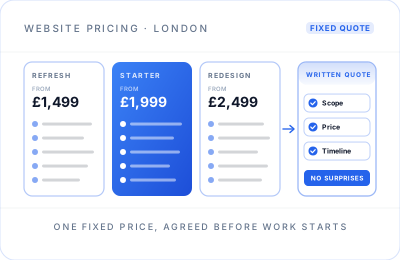
From £1,999 One-off project fee. No cap on pages; scope confirmed in your written quote.- Custom design, mobile-first
- HTML menu pages you can edit
- Opening hours, map and directions
- Order-ahead and delivery links
- Events and private hire enquiry form
- Local SEO setup, café schema and GA4
- 30 days of support after launch
Café + Roastery Shop
Price Quoted Fixed written quote after a free discovery call.- Everything in Starter
- Shopify or WooCommerce bean shop
- Origins, roast levels and grind options
- Coffee subscriptions
- Wholesale enquiry route
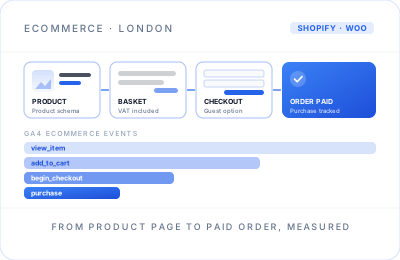
- GA4 ecommerce tracking
Not included: domain, hosting and third-party ordering fees. For ongoing visibility in your neighbourhood, see local SEO and Google Business Profile optimisation.
Coffee customers measured at scale. A London site redesigned and tracked.
At Costa Coffee I worked on digital measurement and reporting, turning app and web behaviour into insight the business could act on. For a website redesign, London FS, a London mortgage broker, now runs its website, analytics, search, email marketing and CRM management, and social as one connected system, reviewed every month, with every enquiry tracked to its source.
Read the London FS case studyCoffee shop website design in London, plus local SEO that fills tables.
London has thousands of cafés, and most of them are competing for the same few seconds of attention on a phone screen. Good coffee shop website design is less about big imagery and more about removing doubt: is it open, is there space, do they do oat milk, can I order before I get there? Answer those quickly and the visit usually follows. For bakeries, the same goes for what came out of the oven this morning and when it tends to sell out.
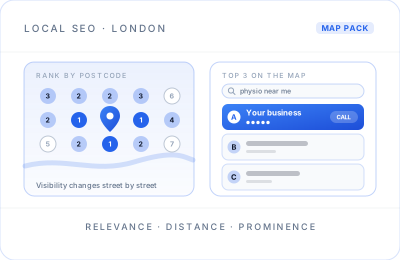
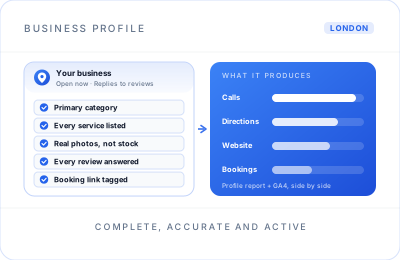
Searches like “coffee near me”, “brunch in Peckham” or “laptop-friendly café Shoreditch” are decided mostly by distance and by your Google Business Profile, with your website acting as the confirmation step. That is why the build matters for local SEO: your name, address and hours match everywhere, the menu is readable text rather than a scanned PDF, and café schema tells search engines exactly what you are. A properly maintained Google Business Profile, with real photos and steady reviews, does the rest.
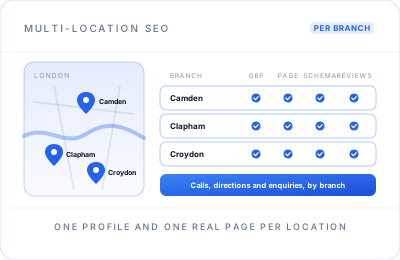
If you run more than one site, each café gets its own page with its own hours, menu differences and map, which is the basis of multi-location SEO. Roasters and bakeries selling online need a shop that handles grind options, subscriptions and delivery zones, built as an ecommerce website. And because regulars are your best customers, a simple newsletter sign-up connected to email marketing gives you a way to fill quiet afternoons that does not depend on algorithms.
I work remotely with independent cafés, coffee shops, roasters and bakeries across London. You get a fixed starting price, one point of contact and a website you own outright.
Café website questions.
Cost, menus, ordering, local search, allergens and private hire.
A café website starts from £1,999 as a one-off fee, covering a custom design, menu pages, opening hours, a map, order-ahead links, local SEO setup and GA4 tracking. Pages aren't capped; the scope is confirmed in your written quote. If you also want an online shop for beans or subscriptions, ecommerce builds start from £2,499.
A web page, almost always. An HTML menu reads properly on a phone, loads quickly, can be updated in a minute and lets Google see your dishes and prices. A PDF is fine as an extra download for anyone who wants to print it, but it should never be the only version of your menu.
Yes. I connect your website to the ordering tools you already use, whether that is a click and collect system, your till provider's online ordering or your delivery app listings, and make the order button obvious on mobile. A fully custom ordering setup can be done too, but it is scoped and quoted separately.
Distance matters most, so no café ranks everywhere. What you control is a complete Google Business Profile, accurate opening hours, the right categories, fresh photos, steady reviews and a website that clearly states your address and neighbourhood. I set these foundations up at launch and can continue with ongoing local SEO.
If customers can order food online, Food Standards Agency guidance says allergen information must be available before they complete the purchase and when the food is delivered. For walk-in only cafés, the website should at least explain how customers can get allergen information. Check the current FSA guidance for your setup.
Yes. I add an events page for tastings, workshops or live music, and a private hire enquiry form that asks for the date, guest numbers and budget, so you get useful enquiries instead of vague emails. Every enquiry is tracked in GA4, so you can see how much hire business the website brings in.