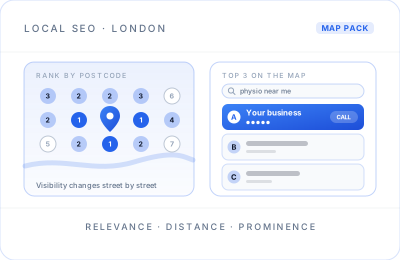
In London, “local” means a few streets, not a few miles.
Google says it ranks local results on three things: relevance, distance and prominence. In a small town, distance barely matters. In London it decides almost everything: a physio in Clapham rarely appears for someone searching in Islington, however good the practice is.
So I plan local SEO around where your customers actually are. Your profile and listings earn relevance, your reviews and local mentions build prominence, and your website backs both up with pages that answer the questions people in each area ask. Then I measure it the way I measured enterprise sites for years: by calls, bookings and enquiries, not by a screenshot of one ranking.
Six signals that decide who shows up nearby.
Google Business Profile
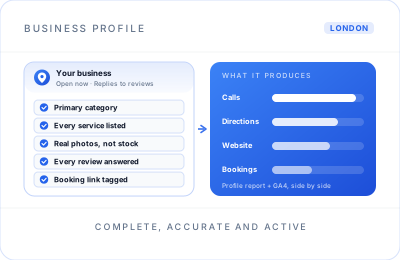
Your profile is your map pack listing. I get the categories, services, photos and hours right, then keep it active. The detail is on the Google Business Profile optimisation page.
NAP Consistency & Citations
The same name, address and phone number on Apple Maps, Bing Places, Yelp and the directories your sector uses. Old addresses, duplicates and tracking numbers found and cleaned up.
Location & Service Pages
Pages for the areas you genuinely serve, each with its own local detail, proof and next step, never the same page with the borough name swapped.
Reviews Strategy
A simple routine for asking every customer, plus replies that show you're listening. No incentives and no filtering out unhappy customers, which Google's review policies don't allow.
Local Links & Mentions
Links that make sense for a London business: suppliers, trade bodies, local business groups, community sponsorships and neighbourhood press. No bought link packages.
Calls & Directions in GA4
A tagged profile link, click-to-call and direction clicks recorded as GA4 events, and the profile's own call and direction figures reported alongside them.
Remote, Across Every London Borough
I work remotely with businesses across London. Local rankings are shaped by where your customers search from, not where your consultant sits, so everything runs through video calls, shared reports and delegated access to your accounts.
Foundations first, then month-by-month momentum.
The first month fixes what is holding you back. After that, local SEO is steady work: reviews, content and links, reported every month.
Local Visibility Audit
Where you appear today across a grid of London postcodes, who beats you in the map pack and why, and the state of your profile and listings.
Profile & Citation Clean-Up
Profile completed and corrected, then your business details made consistent across the listings that matter, starting with the ones customers actually use.
Area & Service Page Plan
Which areas deserve their own page, what each one must say, and how they link to your service pages. Written or improved in priority order.
Review Routine
A short link, a message template and a moment in your process to ask. Plus reply templates, so every review gets a genuine answer.
Links, Posts & Content
Local link opportunities pursued, profile posts published, and new or improved pages where search data shows demand you aren't meeting yet.
Enquiry-Led Reporting
Calls, direction requests, website visits from the map and GA4 enquiries, with what changed and what I'm doing next month.
Thirty-two boroughs don't need thirty-two copies.
The quickest way to damage a local site is a page for every borough with the name swapped. Here is the difference between that and location pages worth having.
| Doorway pages | Location pages done properly | |
|---|---|---|
| Which areas | Every borough, whether you work there or not | Only the areas you genuinely serve |
| The words | One template, place name swapped | Written for that area: who you help there, response times, access and parking |
| Proof | None, or the same testimonial everywhere | Reviews, jobs and photos from that area |
| Google's view | Named as a violation in Google's spam policies | Useful pages that can rank on their own merit |
| What visitors do | Spot it and leave | Find the answer and get in touch |
More than one branch?
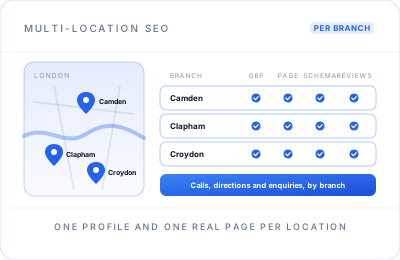
Each real, staffed location can have its own profile and its own page, and that is a different job from ranking one business across many areas. If you run several London sites, see multi-location SEO. If you trade from home or visit customers, a service-area profile with the address hidden is the honest set-up, and I'll configure it that way.
A London service business, run as one tracked system.
London FS, a London mortgage broker, had a limited digital presence and relied almost entirely on referrals. SEO, covering technical fixes, keyword targeting, regular content and a full recovery after a migration dip, ran alongside the website redesign, GA4, a Google Ads trial, email marketing and CRM management as one programme, with results reviewed together every month.
Read the London FS case studyLocal SEO London businesses can measure, borough by borough.
When someone types “emergency plumber near me” or “osteopath Wimbledon”, Google shows three businesses on a map before any ordinary result. Those three places take a large share of the calls. Getting into them is not about tricks; it is about giving Google a clear, consistent and trustworthy picture of what you do and where you do it.
That picture comes from several places at once. Your Google Business Profile is the listing itself. Directories and map apps confirm your name, address and phone number. Reviews tell Google, and the customer, that real people chose you. Your website carries the most weight of all: service pages that explain what you offer, and area pages for the parts of London you genuinely cover. If any of those disagree, visibility suffers: an old address on one directory and a new one on your website is enough to create doubt about which is right.
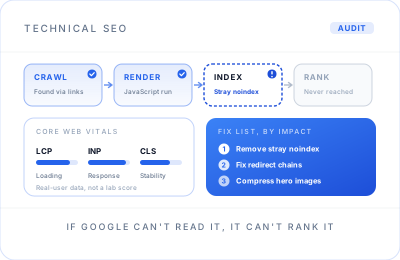
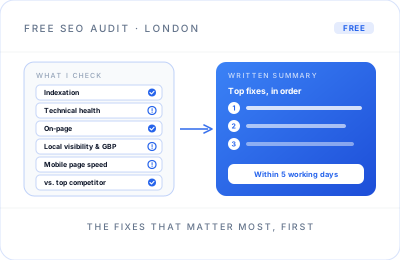
Local SEO also depends on a site that loads quickly and can be crawled properly, so I check the technical SEO basics before writing a single area page. Businesses with several branches need a different structure again, which I cover under multi-location SEO. If you want to know where you stand before committing, start with a free SEO audit.
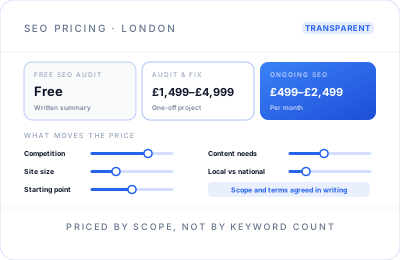
I work remotely with clinics, trades, professional firms and independent shops across all London boroughs, and every engagement runs directly with me. You keep full ownership of your profile and of every listing I create or correct. Ongoing work typically falls between £499 and £2,499 a month depending on competition; the full breakdown is on my SEO pricing page. For the wider picture of how I approach search, see my SEO services.
Local SEO questions.
Cost, timescales, area pages and how results are measured.
Local SEO sits within my usual ongoing SEO range of £499 to £2,499 per month. Where you land depends on how crowded your category is and how many areas you serve; a single-location business in a quieter niche sits at the lower end. You get a written scope before any work starts.
Fixing an incomplete profile and inconsistent listings can improve map visibility within weeks. Crowded London categories usually need three to six months of steady reviews, content and local links before the gains hold. I report monthly on calls, direction requests and enquiries, so you can judge the trend yourself rather than take my word for it.
In the map pack it is difficult, because Google weighs distance from the person searching. In the ordinary results it is realistic with a genuinely useful page for each area you serve. I won't create virtual offices or borrowed addresses to fake a presence; Google can suspend profiles that do.
Doorway pages are near-identical pages made only to rank for each town or borough, usually with the place name swapped. Google's spam policies treat them as a violation, and visitors spot them instantly. I only build location pages for areas you actually serve, each with real local detail, proof and a clear next step.
No. Local rankings depend on where your customers search from and what your business offers, not on where your consultant sits. I work remotely with businesses across London using video calls, shared reports and delegated access to your profile. For London clients I can arrange an in-person workshop when it genuinely helps.
I tag the website link on your Google Business Profile so GA4 can separate map visits, record calls and form submissions as conversions, and read calls and direction requests from the profile's own Performance report. Visibility is checked across a grid of London postcodes, because a single ranking check from one spot is misleading.