An Online Shop Sitting Next To A Physical Premises, Not Instead Of It.
Most local retail customers move between online and in-store without thinking about it: checking stock online before walking in, ordering for click-and-collect, or asking a question in person before buying online later. The website has to support that back-and-forth clearly, rather than treating the online shop as a separate business from the shop on the high street.
For a pharmacy specifically, the online shop also has to carry the same level of care as the counter does: the right registration, a genuine pharmacist consultation step before anything restricted is sold, and accurate, non-misleading claims about what a product actually does.
Built For Pharmacy And Local Retail.
Product & Category Pages With Schema
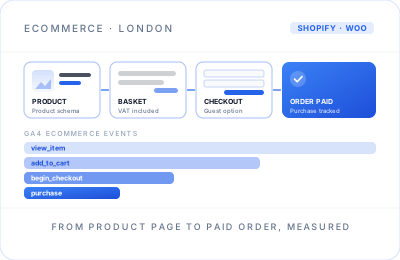
Product and category pages structured with proper schema markup, so listings can be picked up cleanly by search engines, Google Shopping and AI shopping answers, not just by someone browsing the site directly.
GPhC Registration Displayed And Checkable
For a pharmacy: the pharmacy's GPhC registration shown clearly and linked to the public register, since any pharmacy providing services online in Great Britain, exactly as in a physical premises, must be registered and meet GPhC standards.
MHRA Registered Seller Status Shown
For medicines sold online: the business's entry on the MHRA's Register of Retailers of Medicines shown and linked, which is the current GB requirement. The old EU distance-selling logo now only applies in Northern Ireland, not Great Britain, so the site points to the correct, current register instead.
A Genuine Pharmacist Consultation Step
For pharmacy-only medicines sold online, a real two-way consultation step before the sale completes, not just an automated question-and-answer form, in line with GPhC's guidance on distance sale of medicines.
Click & Collect And Delivery Made Clear
Stock and collection options shown honestly per product and per location, so a customer knows before they order whether they're collecting in an hour or waiting for delivery.
Honest Health Claims
Product claims that match what's actually licensed or evidenced for that product, rather than implied benefits the product can't support.
Secure, Working Checkout
A payment and checkout flow that's actually tested end to end, including stock and order confirmation, not just a design mock-up of one.
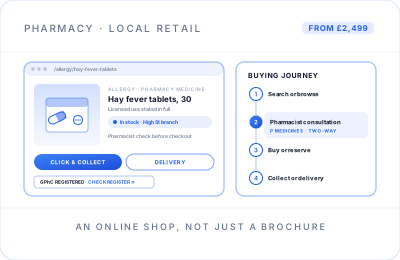
From Browsing To Collection Or Delivery.
Search or browse
A specific product search, or browsing a category, either directly on the site or via a search engine or AI shopping answer.
Check credentials for restricted products
For pharmacy-only medicines, a short, genuine consultation step before the order can complete.
Buy or reserve
Order online for delivery, or reserve for collection, with real stock and timing shown rather than a generic “in stock” label.
Collection, delivery and after-sales
A clear collection or delivery experience, with an easy way to ask a follow-up question afterwards.
What The Site Avoids, And What It Says Instead.
Examples of the patterns worth avoiding, matched to current GPhC, MHRA and ASA expectations. Your pharmacist or compliance lead has the final say on wording.
| What to avoid | What to say instead |
|---|---|
| Selling a pharmacy-only medicine with no consultation step | A genuine two-way pharmacist consultation before the order completes |
| Health claims that imply a cure for a serious condition | Claims that match the product's actual licensed indication, with medical advice signposted where appropriate |
| No visible registration information | GPhC registration and MHRA registered-seller status shown and linked to the public registers |
| The old EU "distance selling" logo, now GB-incorrect | A link to the current MHRA Register of Retailers of Medicines, which is the correct GB scheme since January 2021 |
What The Website Plans Around
- GPhC registration. Pharmacies in Great Britain providing services online must be registered with the GPhC and meet the same standards as a physical registered pharmacy, including the safeguards set out in GPhC's guidance on distance sale of medicines, such as robust identity checks and genuine two-way consultation rather than an automated form alone.
- MHRA Register of Retailers of Medicines. GB-based online sellers of medicines register with the MHRA so the business can be checked on its public register. The EU common “distance selling” logo stopped applying in England, Scotland and Wales from 1 January 2021 and now only applies in Northern Ireland, so a GB pharmacy site should point to the current MHRA register rather than displaying that older logo.
- Medicines classification. Prescription-only medicines cannot be sold or advertised directly to the public; pharmacy-only medicines can be sold online but only through a pharmacist-led process; only general sale list products can be sold with no pharmacist involvement. The site is planned so each product sits in the correct category with the right buying process attached.
- ASA CAP Code, medicines and health claims. Health-related advertising claims need to be capable of substantiation and must not discourage essential treatment or imply a serious condition can be self-diagnosed or self-treated without medical supervision.
These are short summaries the site is planned around, not the full rules, and this is not legal or regulatory advice. GPhC, MHRA and ASA requirements for online pharmacy and medicines sales are detailed and can change, so check current guidance and have your pharmacist or compliance lead confirm registration details, product classification and all claims before anything goes live.
Pharmacy & Retail Website Pricing.
An online shop is a bigger build than a brochure or lead-generation site, since it needs product structure, checkout and stock handling in place before launch. A single pharmacy or local retailer with a defined catalogue usually fits the Starter tier; a larger catalogue or multiple branches gets a fixed written quote.
Starter Online Shop
From £2,499- Product and category page structure for a defined catalogue, fully delivered: custom design, built and launched, yours outright.
- Payment gateway and checkout integration, tested end to end, with stock and order confirmation working correctly.
- GPhC and MHRA registration display where applicable, and the correct pharmacist consultation step built into the restricted-product journey.
- Core buyer journeys mapped: search, browse, buy or reserve for collection, built around how your customers actually shop.
- Product and category SEO, schema and AIO readiness, plus GA4 ecommerce tracking.
- 30 days of support after launch.
Multi-Branch / Larger Catalogue
- Scaled to a larger catalogue or several branch locations
- Per-branch stock and collection handling
- Consolidated reporting
- 1Discovery callFree, 30 minutes
- 2Written scopeWhat's in and out
- 3Fixed priceAgreed before work starts
I haven't built a pharmacy or retail website before, and I won't claim otherwise. What I bring is directly relevant even so: retail and consumer-brand analytics experience through River Island and Costa Coffee, and GSK Consumer Healthcare experience on the health side, which is close to exactly this combination of retail and regulated health product. The discipline that matters here, correct product classification, honest claims, and a checkout that actually works end to end, transfers directly.
Pharmacy & Local Retail SEO
Search behaviour here splits between specific product searches (someone looking for a named product, in stock, nearby or delivered fast) and local “pharmacy near me open now” style searches. Product and category pages with proper schema markup are what let both traditional search and AI shopping answers surface the right product and the right branch.
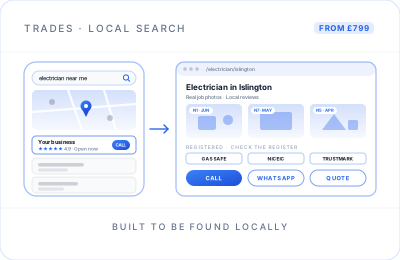
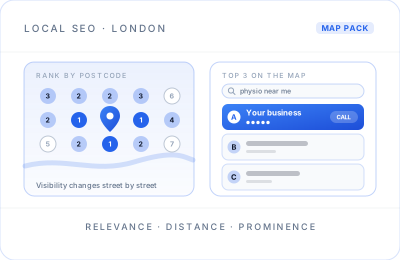
For the click-and-collect side of the business, the same local SEO fundamentals used across the trades sector on this site apply directly: a complete Google Business Profile, accurate opening hours, and genuine reviews all help a local pharmacy or retailer show up for “near me” searches, not just product searches.
Where a business runs several branches, consistent product and stock information across every location page matters for both ranking and simply not frustrating a customer who turns up expecting stock that page said was there.
Pharmacy & retail website questions.
A Starter Online Shop costs from £2,499, fully delivered: product and category structure for a defined catalogue, a tested payment and checkout flow, GPhC and MHRA registration display where applicable, core buyer journeys mapped, on-page SEO and AIO readiness, and GA4 ecommerce tracking. Larger catalogues or multiple branches get a fixed written quote after a free discovery call.
No, prescription-only medicines cannot be sold or advertised directly to the public online. Pharmacy-only medicines can be sold online, but only through a genuine pharmacist-led consultation step, which is built into the site rather than left as an afterthought.
Not in Great Britain. That logo stopped applying in England, Scotland and Wales from 1 January 2021 and now only applies in Northern Ireland. A GB pharmacy site should instead show its entry on the MHRA's Register of Retailers of Medicines.
Yes, the checkout and stock handling are built and tested as part of the site itself, rather than left for you to wire up afterwards.
The site is built with per-branch stock and collection handling, and reporting broken down by branch, quoted after a discovery call once the number of branches and catalogue size are known.
Very much so for the click-and-collect side of the business. “Pharmacy near me” style searches are decided largely on Google Business Profile completeness, accurate hours and genuine reviews, alongside the product-level SEO that helps individual items get found.