Every growing business needs 6 things online. Here's what they are — and why the order matters more than the list.
I get the same call almost every week. A founder, somewhere between two and ten people, decent business, growing slowly, and stuck. They've spent on a website, dabbled in SEO, tried Google Ads, paid someone to "do their social" — and they still can't tell me which of those is actually working. The reason isn't usually that any single thing is broken. It's that the foundation was never properly built in the first place.
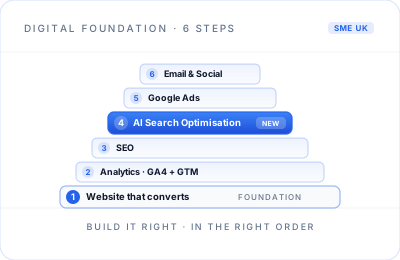
This post is the checklist I wish I could send them before that call. Six layers, in the order I'd build them today, written for a UK SME owner who is sensible with money and hasn't got time to learn agency jargon. No fluff. No selling. Just the foundation.
Why the order matters more than the list
Most SME owners already know the list. They've read enough LinkedIn posts to recite "website, SEO, Google Ads, content, email, social" in their sleep. The problem isn't knowing what to do — it's doing it in an order that compounds.
If you run Google Ads before your analytics work, you're paying for traffic you can't measure. If you do SEO before your website converts, you'll celebrate rankings while your sales stay flat. If you bolt on AI Search Optimisation before you have any authority signals, the AI engines have nothing useful to cite. Each layer leans on the one beneath it. Skip a layer and the layers above wobble.
So the order I use isn't arbitrary. It's the order in which each step makes the next one cheaper, faster and more reliable. Get this right and your marketing budget compounds. Get it wrong and you'll spend the next two years calling agencies and wondering why the numbers never move.
Step 1 — A website that converts (not just exists)
Your website is the foundation. If it doesn't convert, nothing else matters. Every other channel on this list exists to drive traffic to it — so if visitors arrive and leave without acting, you're effectively pouring water into a leaky bucket and arguing with the tap.
The difference between a converting website and a brochure site is intent. A brochure site lists what you do. A converting site answers the visitor's question, builds trust and gives them a single obvious next step. That's it. Most SME websites I audit fail not because they look bad — they look fine — but because there is no clear path from "I'm interested" to "I've contacted you."
Three things every SME website must have above the fold:
- A clear, plain-English statement of who you help and what you do for them. Not a tagline. A sentence a 12-year-old could understand.
- Visible proof — a testimonial, a client logo, a Google review count, a number. Something that says "other people have trusted us and survived."
- One primary call to action. One. Not three. Pick the action that actually generates revenue and make every page nudge toward it.
If your website doesn't do those three things in the first five seconds, you don't need more traffic. You need a better website.
Step 2 — Analytics that actually work (GA4 + Google Tag Manager)
You cannot improve what you cannot measure. Analytics is the foundation of every decision you'll make from here on. And in most SMEs I audit, the analytics are either broken, double-counting, or measuring the wrong things entirely.
The pattern is depressingly consistent. A developer installed GA4 once, nobody set up conversion events, the tracking double-fires on the thank-you page, and the only number anyone looks at is "sessions" — which tells you almost nothing about whether your marketing is working. You're flying with a broken altimeter and wondering why the landings are rough.
What a proper GA4 + Google Tag Manager setup tells you that you can actually act on: which traffic source brings the visitors who buy (not just the visitors who arrive), which pages cause people to leave, how long the buying journey really takes, and which campaigns deserve more budget. That's the difference between guessing and knowing.
Do this step before you spend a penny on paid channels. Otherwise the paid channels become a tax you can't justify.
Step 3 — SEO that builds over time
SEO is your long-term compounding asset. Done properly, it brings organic, intent-rich traffic for years. Done badly, it's the most expensive thing on your marketing P&L because you're paying for it and getting nothing back.
For most UK SMEs the question isn't "should I do SEO?" — it's "local or national first?" If your customers come from within a 30-mile radius (trades, restaurants, clinics, accountants, advisors), do local SEO first: Google Business Profile, NAP consistency, location-anchored content, reviews. Local SEO is faster to move and cheaper to win.
If your customers come from anywhere in the country (SaaS, e-commerce, B2B services, consultancies), national SEO is the play — and you'll need to be more patient. Expect 3 to 6 months to see early movement on competitive UK terms, and 9 to 12 months before SEO becomes a meaningful channel. Anyone promising rankings inside 30 days is either lying or doing something that will burn the site down later.
Start SEO once your website converts and your analytics work. Doing it earlier wastes the rankings.
Step 4 — AI Search Optimisation (AIO) — the new essential
AIO — AI Search Optimisation — is the practice of making your business visible inside answers generated by ChatGPT, Perplexity and Google AI Overviews. In plain English: when a potential customer asks an AI "who's a good accountant near Aylesbury" or "best mortgage broker in Buckinghamshire", AIO is what determines whether your name comes up in the answer or not.
Here's the uncomfortable part. Right now, your business might be completely invisible to ChatGPT. Try it. Open ChatGPT, type your business category plus your town, and ask for the best in the area. If you're not mentioned — and most SMEs aren't — you're missing a chunk of demand that increasingly does its research in AI tools rather than on the Google results page.
AIO sits in step 4 because it works best when steps 1-3 are already in place. AI engines surface businesses with clear positioning, structured information, third-party citations and a real digital footprint. Those are exactly the assets you've just built — a converting website, clean analytics to validate impact, and SEO authority signals.
Two years ago this would have been a "nice to have." In 2026 it's part of the foundation. If you want the full breakdown, I've written a separate piece — what is AIO and why your small business needs it.
Step 5 — Google Ads (once the foundation is in place)
Now you can turn the tap on. Google Ads is the fastest way to buy intent — people actively searching for what you sell, today — which makes it brilliant when the rest of your foundation is solid and a money pit when it isn't.
Why ads without analytics is money wasted: you don't know which keyword drove the lead that closed, you don't know which landing page converted, you can't tell Google's algorithm what a "good conversion" looks like, and so the algorithm spends your budget on whatever clicks the most — not whatever buys the most. The first thing a good Google Ads account needs is conversion data flowing in cleanly. Without that, you're just renting traffic.
Spend on ads when your foundation is built and your numbers tell you that one more lead is worth the money. Spend before that and the ads will quietly empty your bank account while you wonder why nothing is happening.
Step 6 — Email and social (the retention layer)
Email and social aren't the foundation — they're the retention layer that sits on top. Their job is to keep existing customers warm and turn one purchase into many, not to acquire strangers from cold.
Most SMEs do this backwards: they post on Instagram four times a week hoping for new customers, and ignore the email list of people who've already bought from them. Switch it. Build a simple email nurture for past buyers and enquirers; treat social as proof and presence rather than as a primary acquisition channel. The maths is significantly better and the work is significantly less.
FAQ — common questions
Not sure which step your business needs first?
Start a conversation. I'll look at where you are, tell you honestly which layer is missing, and what it would take to fix it. No pitch, no upsell — just a useful conversation.
Start a Conversation