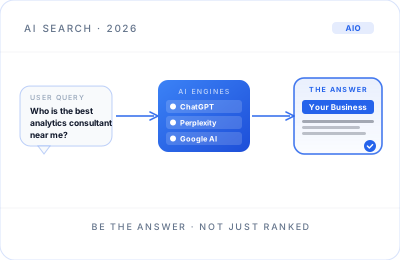
AIO — AI Search Optimisation — is the practice of making your business visible in answers generated by AI tools like ChatGPT, Perplexity and Google's AI Overviews.
If a chunk of your future customers are about to research suppliers inside an AI assistant rather than on a Google results page, AIO is what decides whether your name comes up in that conversation. This post is the plain-English version of what AIO is, how it differs from SEO, and how a small UK business can actually start showing up in AI answers without hiring an agency that charges you for the privilege of explaining acronyms.
What is AIO in plain English?
Think of AIO as the next layer on top of SEO. For twenty-odd years the goal of digital marketing has been "rank on Google." You optimise pages, you earn backlinks, you wait, you climb the rankings, customers click. That model still works — but it isn't the only model anymore.
A growing share of buying research now happens inside conversational AI tools. Someone opens ChatGPT and types "who's a good mortgage broker in Aylesbury" or "best CRM for a 5-person consultancy." The AI doesn't show them a list of ten blue links. It gives them an answer — often two or three businesses, named directly, with a short reason for each. AIO is the work that gets your business named inside that answer.
The simplest way I can put it: SEO helps you rank on Google. AIO helps you appear when someone asks an AI for a recommendation. The first is about being one of many options on a results page. The second is about being one of two or three names the AI confidently puts forward as the answer.
How AI search is changing the way people find businesses
The shift isn't theoretical anymore. According to recent industry reports, an estimated several hundred million people now use ChatGPT each week, and a meaningful share of those sessions involve real-world purchase research — software comparisons, local services, product recommendations. Perplexity and Google's AI Overviews have followed similar growth curves through 2025 and into 2026. The exact numbers vary by source, but every credible tracker points the same way: AI-assisted search has moved from niche to mainstream.
What does that look like for your business? Customers who once would have Googled "accountants in Buckinghamshire" and clicked through five websites are now asking ChatGPT "find me a good small business accountant near Aylesbury who knows e-commerce" — and getting two or three names with reasoned recommendations. They might then verify those names on Google, but the shortlist was decided by the AI.
If your business isn't on that AI-curated shortlist, you don't even get a chance to compete. You're not being beaten on price or proposition — you're being skipped entirely, before the conversation begins.
AIO vs SEO — are they the same thing?
They overlap, but they aren't the same. The fundamentals are shared — clear writing, structured information, useful content, trust signals from the wider web. A site that ranks well on Google has a good head start on AIO. But the optimisation surface is different, and so are some of the signals.
Where SEO and AIO diverge:
- SEO ranks individual pages against keyword queries. AIO rewards passages and concise factual answers an AI can quote inside a response.
- SEO leans heavily on backlinks and click-through rate. AIO leans more on third-party citations, structured data, and whether other trusted sources mention you.
- SEO success is "I rank on page one." AIO success is "I get cited by name when the AI is asked for a recommendation."
- SEO traffic clicks through to your site. AIO visibility may not generate a click at all — the AI may quote you and the user never lands on your page. That changes how you measure it.
The takeaway: keep doing SEO, layer AIO on top, and accept that some of your AI-driven impact will show up as brand searches, direct visits and enquiries rather than as classic organic traffic.
Is your business invisible to AI right now? (How to check)
The test takes 60 seconds. Open ChatGPT (or Perplexity, or Gemini), and type a question a customer might ask — your business category plus your location or specialism. For example: "Who are the best [your category] in [your town]?" Then ask a follow-up: "Can you name three more?" If you aren't mentioned in either answer, you've found your AIO gap.
Common reasons SMEs don't appear in AI answers:
- Your website doesn't clearly state what you do and who you serve in plain factual terms an AI can quote.
- You have minimal third-party mentions — no directory listings, few reviews, no industry citations.
- No structured data (schema markup) explaining your business type, location and services.
- Your content is all marketing fluff and no useful answers to the actual questions buyers ask.
- You're new or you've recently rebranded — AI training data and indexes haven't caught up yet.
What does AIO actually involve?
AIO isn't one tactic — it's a small bundle of changes that, done together, make your business legible and quotable to AI engines. The work usually includes restructuring key pages around clear questions and clear answers, adding FAQ sections that mirror how real customers phrase queries, implementing Schema.org structured data so AI can parse your business type and services, and building authority signals through directory listings, reviews and press mentions.
Content-wise, the biggest single shift is writing for the answer rather than the keyword. A traditional SEO post might open with 200 words of throat-clearing before getting to the point. An AIO-optimised post opens with the direct answer in the first sentence, then explains. That's not just style — it's what AI engines pull from when they need a snippet to cite.
How long does AIO take to show results?
For local and lower-competition categories, businesses can start appearing in AI answers within 4 to 12 weeks of doing the right groundwork. For more competitive national categories, expect 3 to 6 months — and the speed depends heavily on the SEO and authority signals you already have. AIO is faster than traditional SEO in some respects (smaller competitive set, less waiting for backlinks) and slower in others (AI training data updates on its own cadence). Treat it as a 90-day minimum before judging the results.
FAQ — quick answers
Are you invisible in AI search?
Book an AIO audit. I'll check whether your business is appearing in AI answers across ChatGPT, Perplexity and Google AI Overviews — and tell you exactly what it would take to get there.
Book Your AIO Audit