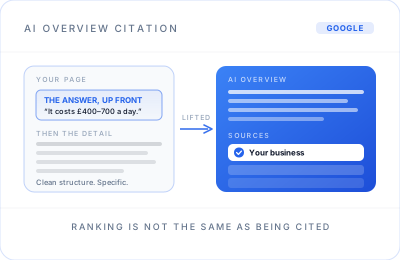
Ranking number one on Google does not guarantee that people will see your website in the way it once did. For some searches, Google now generates an answer directly on the results page. If your content is not one of the sources behind that answer, you can be invisible even when you technically rank.
Google AI Overview optimisation is the work of making your content clear, credible and useful enough to be selected as a source in those answers. It is not a separate replacement for SEO. It is an additional layer: helping a strong website become easy for Google to understand, extract from and cite accurately.
What it means to be cited in an AI Overview
A citation in a Google AI Overview is a link to a source Google has used to support part of its generated answer. It is not something you can buy or switch on. Google selects sources query by query, based on what it considers useful, relevant and reliable for that specific question.
That means there is no guaranteed route to citation. But there are clear ways to improve your chances: make the answer obvious, support it with genuine expertise, structure it well, and ensure the page is technically accessible. Those principles also make the page better for human readers, which is a useful test in itself.
Traditional SEO still matters, it is just not enough on its own
AI Overviews are still informed by content that Google can find, crawl and understand. Fast-loading pages, a clear heading hierarchy, strong internal linking, technically sound markup and genuine topical authority all remain important. If your technical SEO foundation is weak, it is unlikely that an AI Overview strategy alone will compensate for it.
Think of AI search optimisation as a layer on top of good SEO, not a shortcut around it. First, make sure your most useful pages are indexable, helpful and credible. Then make them easier to select as a source by presenting the information in a direct, well-structured way.
Answer the question directly, near the top
If you want to rank in Google AI Overviews, give the reader the answer early. A strong section begins with a clear, self-contained response to the question, then explains the nuance underneath it. Do not make someone work through several paragraphs of background before they reach the useful part.
For example, a page answering “how much does X cost?” should state a realistic range near the top, explain what affects it, and say where the range may not apply. That is more useful to a reader, and it gives Google a clear passage it can understand in context.
Direct does not mean simplistic. You can still explain caveats and complexity. The difference is that the actual answer arrives first, rather than being buried beneath a long introduction.
Structure content so it can be lifted cleanly
Clear headers, numbered steps, short definitions and concise paragraphs make it easier for an AI system to identify the relevant part of a page. Dense, meandering prose makes that harder. The aim is not to write for a robot; it is to make the logic of the page unambiguous.
A useful rule is to make each major section stand on its own. Someone should be able to read the heading and the first paragraph beneath it and understand the answer without needing the rest of the article. Lists and tables are helpful when they genuinely clarify a comparison or a process.
This does not mean every page needs to sound mechanical. It means being honest about the question being asked and precise about the answer you are giving.
FAQ sections and schema markup help, but are not magic
A well-written FAQ section can cover the follow-up questions a potential customer is likely to ask. That makes the content more complete, and it creates clear answer blocks for search systems to understand. The questions need to be real and the answers need to be visible on the page; adding generic FAQs simply for search engines adds little value.
Schema markup has a similar role. Article, Organisation, Person, Breadcrumb and relevant service markup help Google understand the entities and relationships on your site. They do not guarantee a citation, but they remove ambiguity and support the wider technical foundation.
Neither an FAQ nor schema is a magic trick. They work best when they describe a page that is already genuinely useful, accurate and well organised.
Original insight beats generic content
AI systems have no shortage of generic advice to choose from. A page that repeats the same broad recommendations found everywhere else gives Google little reason to treat it as a distinctive source.
The content with the strongest chance of standing out includes something genuinely specific: a real example, a measured result you can substantiate, an expert explanation based on hands-on work, or a practical distinction that only becomes obvious through experience. That is the material people cannot get from a hundred interchangeable articles.
Original insight also builds trust with the human reader. It demonstrates that there is a real person or business behind the page, with a perspective worth listening to.
Why this matters more for small businesses than you might think
Large brands have the resources to compete on volume, but volume is not the only route to visibility. A smaller business with a clear point of view, strong expertise and genuinely helpful answers can create pages that are more useful than generic content from a larger competitor.
That is the opportunity in AI search optimisation. It rewards clarity, specificity and real experience — areas where a sharp small business can compete well. The goal is not to publish more for the sake of it. It is to become the clearest, most credible answer to the questions your customers are already asking.
If you want your business to show up in the answers people are getting now, not just the links they used to click, that is exactly the kind of work I do.
Want to improve your visibility in AI-powered search?
Explore the AIO Search Optimisation service to see how your website can become clearer, more credible and easier for search systems to cite.
Explore AIO Search Optimisation