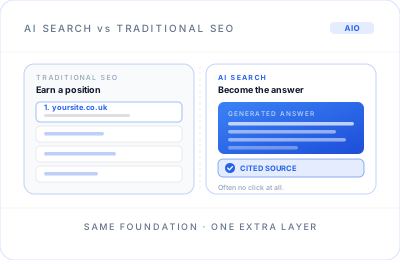
Traditional SEO and AI search optimisation are not opposites, but they are not the same discipline either. Treating them as identical can leave a business visible in a conventional ranking while missing the answer a searcher sees first.
Traditional SEO helps a page earn visibility in Google’s organic results. AI search optimisation helps make that content clearer, more useful and easier for search systems to select as a source in generated answers. The strongest approach is not choosing one over the other; it is building the foundation and then adding the extra layer.
What traditional SEO still does well
Traditional SEO is about earning a ranking position in search results. It covers technical health, crawlability, page speed, internal linking, keyword targeting, relevant links from other websites and useful, in-depth content. These fundamentals help Google understand what a page is about and whether it deserves to appear for a particular search.
This still matters. It is the foundation almost everything else is built on. If a website is slow, difficult to crawl, unclear about its subject or thin on useful content, it is unlikely to perform well in either traditional results or AI-generated answers.
What is different about AI search?
For some searches, Google presents a generated answer above or alongside the familiar list of links. That answer is built from sources Google judges to be useful for the specific question. If your content is not selected as a source, a good conventional ranking may receive less attention than it would have in a links-only result.
The signals overlap with SEO, but they are not identical. Clear answers, clean structure, self-contained passages and genuine specificity make it easier for a search system to understand what your page contributes. A page can be well optimised for a keyword and still make the answer difficult to extract.
| Traditional SEO | AI search optimisation |
|---|---|
| Helps pages rank in organic search results. | Helps useful content be understood and considered as a source in generated answers. |
| Focuses on technical health, relevance, authority and search intent. | Builds on those foundations with answer-first writing, extractable structure and original insight. |
| Success is commonly measured through rankings, traffic and conversions. | Success also includes whether a brand or page is visible in relevant AI-driven answers. |
A simple example
Imagine two pages that both answer the question, “How much does X cost?” One opens with three paragraphs of company background before it reaches a number. The other states a realistic price range in the first two sentences, then explains the detail and caveats afterwards.
Both pages might rank similarly in traditional SEO terms. But the second page gives the reader — and the search system — a clearer, self-contained answer. That makes it a stronger candidate to support a generated response.
The lesson is not to remove nuance. It is to put the answer before the explanation. Be clear first, then be comprehensive.
What this means practically
You do not need to abandon SEO fundamentals. You need to build a second layer on top of them. Start by making your important pages technically sound, easy to navigate and relevant to real customer questions.
Then improve how the content answers those questions:
- Lead with a direct, accurate answer near the top of the relevant section.
- Use clear headings, short paragraphs and lists where they genuinely make the information easier to follow.
- Give each section enough context to stand on its own if it is surfaced outside the page.
- Add specific, original insight that a generic competitor cannot simply copy.
- Support the page with clear author, organisation and article information so the source is easy to understand.
That is the practical role of an AI SEO consultant in the UK: not promising a guaranteed place in every generated answer, but making sure your website is technically solid and your best expertise is presented in a way modern search systems can use.
Why this is an opportunity for small businesses
Large competitors often have vast libraries of older content built for traditional ranking, not for direct, citation-ready answers. Reworking that content at scale takes time. A smaller business can move faster by making a focused set of high-value pages genuinely clear and specific now.
This is why AI search optimisation is an opportunity, not just a threat. It rewards expertise that is explained clearly. You do not need to publish hundreds of generic articles. You need to become a more useful source than the generic alternatives for the questions your best customers are asking.
If you want your content built for how people are searching now, not just how they searched five years ago, that is exactly what AI search optimisation is for.
Want content built for AI-powered search?
Explore AIO Search Optimisation to see how clear, credible content and a sound SEO foundation can improve your visibility in modern search.
Explore AIO Search Optimisation