In 2005, branchless banking felt fringe
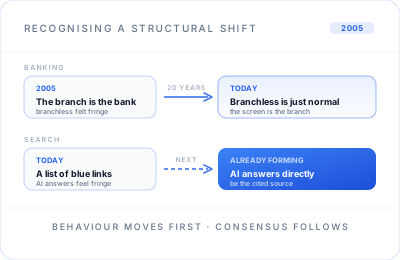
In 2005, as part of my MSc, I wrote my dissertation on a question that felt fairly fringe at the time: was banking moving away from branches and bricks and mortar, towards something branchless?
It is worth remembering how settled that world looked. The branch network was the bank. It was where accounts were opened, where trust was established, and where the relationship was assumed to live. Online banking existed, but it was widely treated as a convenience layer bolted onto the real thing rather than a replacement for it. Asking whether the branch itself might eventually become optional was not a mainstream position.
What made the question interesting was not a prediction about technology. It was a question about behaviour: if customers could get what they needed without going anywhere, how long would the physical network stay central to how banking actually worked? That is a customer question before it is a technology one, and it is the same shape of question I find myself asking now.
What I got right, and what I did not see coming
The direction held. Two decades on, branchless is not a thesis question; it is simply how a great many people bank. Branch networks have contracted sharply, and for a large share of customers the primary relationship with a bank is now a screen rather than a counter. That much is now uncontroversial in a way it genuinely was not in 2005.
The honest caveat is that direction is the easy part. Any view formed in 2005 would have been incomplete on mechanism and on pace — the smartphone had not yet reshaped what “access” meant, and the speed of branch closures outran what most people were modelling at the time. Getting the direction right and the specifics wrong is the normal outcome of this kind of thinking, and it is worth saying so plainly rather than claiming more foresight than anyone actually had.
Twenty years later, I am making a similar bet
Here is why this matters now, not just as a nice story. AI search, Google AI Overviews, ChatGPT and Perplexity increasingly answer questions directly. That feels like the same kind of shift I wrote about in 2005: a change in how people access something they once took for granted.
Not everyone believes the change will matter yet. Many small businesses are still not paying attention to it. That is understandable: large shifts are rarely obvious while they are still forming. Banking in 2005 was not yet the digital-first experience we now know. Branchless banking was a question, not a default.
If there is a throughline, it is this: I tend to trust what customer behaviour is already doing over what an industry says it believes. Behaviour usually moves first, quietly, and the commentary catches up later. That is why I pay more attention to how people are actually looking for answers today than to whether the sector has agreed yet that it matters.
Why I am telling you this
Not to claim I can predict the future. Twenty years of watching an industry shift from a fringe academic question to simply how things work has taught me something more useful: take early signals seriously rather than waiting for a complete consensus.
That is the lens I bring to advising clients on AI search now. It is not about chasing hype or claiming that every new tool changes everything. It is about recognising the shape of a genuine structural shift and helping businesses respond while there is still time to build an advantage.
If you want to talk through what that shift might mean for your business, get in touch.
Curious about what AI search means for your business?
Learn more about the thinking behind JS Digital IQ, or start a conversation about the changes shaping how your customers find answers today.