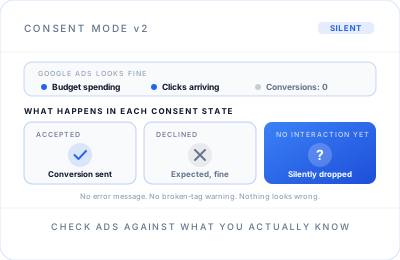
Here is a genuinely frustrating problem: Google Ads can look completely healthy. Campaigns are running, budget is spending and clicks are coming in, while the account quietly records few or no conversions.
That does not always mean nothing is converting. Sometimes the conversion data simply is not reaching Google Ads in a usable way. One cause is a flawed GA4 Consent Mode setup, where the relationship between your consent banner, Google Tag Manager and Google tags is not behaving as intended.
How this actually happened
I recently diagnosed exactly this on a client account. Google Ads showed spend and clicks, but recorded conversions had flatlined to almost nothing. The client knew from their own inbox and CRM that leads were genuinely coming in.
The obvious explanations all led nowhere. The tracking had not simply been removed. The campaigns were still active. Targeting had not suddenly disappeared. The real issue was more subtle: a timing gap in the Consent Mode v2 implementation.
Consent Mode communicates a visitor’s consent choice to Google so tags can adjust their behaviour. In this case, the consent defaults and updates were configured in a way that caused some conversion signals to be lost in certain consent states. Nothing displayed a clear error. The signals were simply absent when they were needed.
The client remains fully anonymised here. The point is not the account; it is the pattern. When consent tooling and marketing tracking are implemented separately, a small gap between them can have a large effect on the data used to evaluate and optimise advertising.
Why this is so easy to miss
Consent Mode problems do not always announce themselves with a broken-tag warning. Campaigns can keep running. The account can still look active. And Google Ads reporting can contain a mixture of observed and, where eligible, modelled conversion data, which makes the problem less obvious from the surface.
Unless you compare reported conversions with an independent source of truth — a CRM, booking system, payment system or monitored inbox — a meaningful gap can continue unnoticed. The team may conclude that campaigns are underperforming when the more immediate problem is measurement.
That is why this is worth checking deliberately rather than assuming everything is fine because nothing looks visibly broken.
What to check in your own account
- Compare Google Ads conversions with an independent record. Use your CRM, inbox, booking system or sales records. The totals will not always match exactly because attribution differs, but a persistent and meaningful gap is a reason to investigate.
- Check that the consent banner and tracking setup communicate correctly. Consent Mode does not create the banner; it receives and acts on the consent choices the banner sends. Confirm that the required consent signals are passed to your Google tags in the right order.
- Test every relevant consent state. Test accept, decline and no interaction yet. Confirm that the expected Google Ads and analytics behaviour occurs in each state, rather than testing only the option you personally tend to click.
- Use the available diagnostics. Google Tag Assistant and Google Tag Manager Preview can show whether consent settings and conversion tags are firing as expected. In Google Ads, check conversion-action status and Diagnostics rather than relying only on campaign-level charts.
The fix, once found, was straightforward
This is the frustrating part: once identified, correcting the timing gap was a relatively quick fix. The hard part was never the solution. It was knowing to look in the right place, because nothing about the account’s surface behaviour pointed there.
Consent defaults need to be established before tags send measurement data, and updates should happen as soon as a visitor confirms a new choice. Depending on the website and consent platform, that can require careful coordination between the banner, Tag Manager and the Google tag.
If your Google Ads conversion numbers do not match what you know is happening in the business, it is worth having someone check properly rather than assuming the campaigns themselves are underperforming. This is technical implementation work, and consent obligations also need appropriate legal or privacy advice for your specific situation.
Not sure whether your Google Ads tracking is reliable?
Explore the Google Ads service to see how clean conversion measurement can support better reporting, smarter optimisation and more confident decisions.
Explore Google Ads