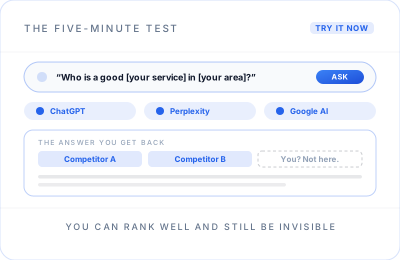
Google is no longer the only place people use to find a business like yours. Some potential customers now ask ChatGPT, Perplexity and similar tools directly. If you have never checked whether your business appears in those answers, it is worth five minutes to find out.
This is not a perfect scientific audit. AI-generated answers can vary by question, location, time and the information available to the tool. It is, however, a useful first signal of whether your business has any visibility in the places where people are beginning to ask for recommendations and advice.
Try this right now
Open ChatGPT or Perplexity and ask a question a potential customer might genuinely ask. For example:
- “Who is a good [your service] in [your area]?”
- “What should I look for in a [your service] provider?”
- “How much does [your service] usually cost in [your area]?”
Look at what comes back. Is your business mentioned? Are competitors mentioned? Which sources or websites are referenced? Repeat the test with a few specific, natural variations rather than relying on one prompt alone.
Do not be surprised if the result is disappointing. Many small businesses are absent from these answers, not because they are bad at what they do, but because their website and wider digital presence do not yet give AI search tools a clear, trustworthy source to draw from.
Why this is different from ranking on Google
Traditional SEO is largely about earning a position in a list of links. AI tools work differently. They can synthesise an answer from sources they judge useful and clear, then present that answer directly. The person asking the question may never click through to a website at all.
That means the old measure of success — “Am I on page one?” — does not fully capture whether you are being surfaced or recommended inside AI-generated answers. A business may rank well for a conventional search and still be absent from a relevant AI response.
The fundamentals still overlap. Strong technical SEO, clear topical expertise and credible information help in both places. AI search optimisation adds another question: is your expertise easy for these systems to understand, extract and explain accurately?
What actually helps
A generative engine optimisation consultant will not promise that a business appears in every answer. What they can do is improve the signals that make a business easier to understand and consider as a source. In practice, that means:
- Clear, direct answers to specific customer questions on your own website, rather than vague marketing copy.
- Specific, factual information about locations, services, pricing ranges, credentials and processes, where it is appropriate to publish it.
- Genuine expertise and useful detail, not thin content that says the same thing as every competitor.
- Clean technical foundations so your important pages can be found, crawled and understood.
- Consistent brand information across the website and other trusted places where customers and search systems encounter the business.
This is not a completely different skill from good content and clear communication. It is closer to explaining your expertise as you would to a real person, with the evidence and specifics that help them trust the answer.
Why it matters more the earlier you act
Many small businesses have not yet made AI visibility a deliberate part of their marketing. That creates an opening for businesses that start with a focused, useful body of content rather than waiting until the competition is much heavier.
The opportunity is not a shortcut. It is to become the clearest and most credible source for the questions your best customers already ask. The earlier you build that foundation, the more time it has to earn trust across both traditional and AI-powered search.
If you tried the test above and did not like what you found, that is exactly the kind of gap worth talking through.
Want your business to become a more useful AI-search source?
Explore AIO Search Optimisation to see how stronger content, technical foundations and brand signals can improve your visibility in AI-powered search.
Explore AIO Search Optimisation